2/21/2025
how to run a megadungeon in 1:1 time
Anyone who has been playing D&D long enough has heard of the megadungeon. A mythical adventure locale where the halls of the subterranean depths sprawl out endlessly filled with factions, traps, and treasure. Running such an adventure locale comes with some serious logistical challenges when trying to maintain the rules as written by using 1:1 time.
I'm not alone in spotting this problem. Keeping a campaign on a strict 1:1 clock can strain even the most dedicated group, especially given OD&D's loose framework and the demands of a megadungeon's scale. The rules offer indirect guidance, leaving much to be puzzled upon, and the abstract nature of timekeeping can clash with the granular detail of dungeon exploration. Yet, I've done it and it's been a rewarding ride. In this post, I'll walk you through how I made it work, drawing directly from the original rulebooks to show you how to harness their brilliance for your own game.
1:1 time
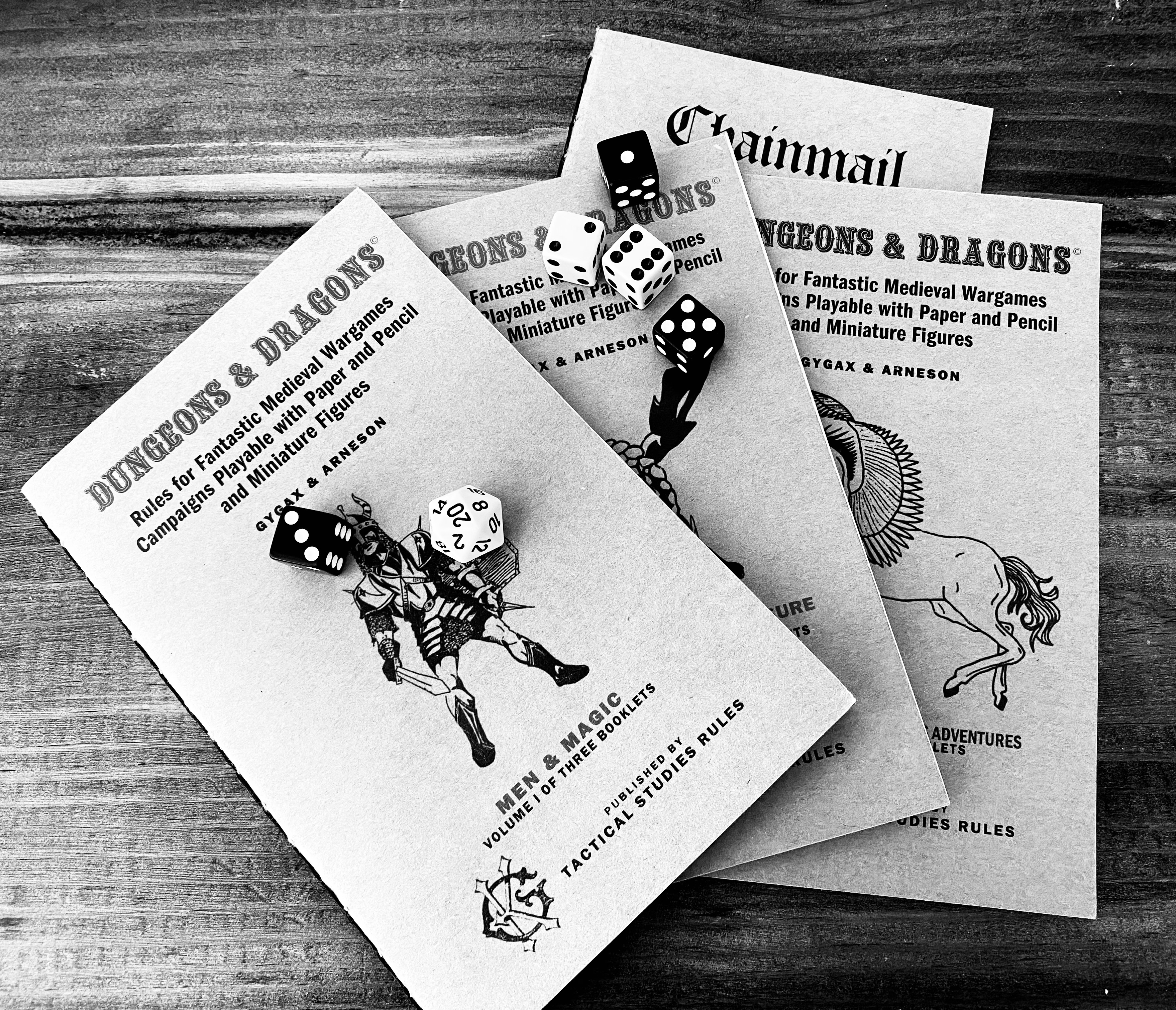
In the simplest terms 1:1 time is 1 day on the real calendar is equal to 1 day in the game. The way this is adjudicated is hotly debated, but most agree that every day that passes between sessions is also passing in the game world. These the rules as they are written in the 1974 version of the game:
"As the campaign goes into full swing it is probable that there will be various groups going every which way and all at different time periods. It is suggested that a record of each player be kept, the referee checking off each week as it is spent.
the passage of time thus:
Dungeon expedition = 1 week
Wilderness adventure = 1 move = 1 day
1 week of actual time = 1 week of game time
The time for dungeon adventures considers only preparations and a typical, one day descent into the pits.
The time for Wilderness expeditions would include days of rest and recuperation.
Actual time would not be counted off for players “out” on a Wilderness adventure, but it would for those sequestered in their dens, hidey-holes, keeps, castles, etc., as well as for those in the throes of some expedition in the underworld."
-- THE UNDERWORLD & WILDERNESS ADVENTURES
These rules were not only prescribed by the original game designers, but also, as many are rediscovering, they are necessary for running a game with multiple parties. Time working in this way also acts as an engine to drive the game forward enticing players to engage with the game in ways they wouldn't have in conventional play as there is an immediate sense of missing out should you not participate with the game between sessions.
why megadungeons are great
The fantasy of endless halls filled with dark creatures and unpredictable traps that descend into the earth ever deeper is one well known in the genre. From the mines of Moria to the dark dungeons built beneath castles and fortresses in the Hyborean Age, these dungeons are a regular source of inspiration for running adventure games, so much so that the first fantasy campaign took place in the vicinity of such a locale.
blackmoor & tonisborg
Megadungeons have deep roots in the hobby's origins. Dave Arneson's Blackmoor set the stage, born from his wargaming experiments in the Twin Cities. Around the same time, Greg Svenson's Tonisborg emerged as another labyrinth of legend, packed with traps and mysteries. These weren't tidy little dungeons with a beginning, middle, and end—they were vast, untamed sprawls that dared players to keep coming back. The 1974 rules in Monsters & Treasure (Book II) and The Underworld & Wilderness Adventures (Book III) reflect this ethos: a framework built for referees to create “dungeons” (Book III, p. 3) that evolve over time, perfectly suited for the megadungeon's grand scale.
treasure for the mid-game
By the time your characters hit mid-level they're hungry for loot to fund strongholds, hirelings, and those sweet +1 swords. Megadungeons deliver. The megadungeon serves as a controllable income stream that is far more predictable than the wilderness as the dungeon is expected to have smaller groups of enemies encountered as well as treasure possible on the other side of every door.
easy zero-prep
Despite the conventional narrative around megadungeons being prep-heavy nightmares, I found they are actually are low-prep wonders. Using The Strategic Review Solo Dungeon Generation rules or those found in Appendix A of the DMG, a referee can run an endless dungeon on the fly: dungeon rooms, treasure, and monsters. With a simple wandering monster table specific for your dungeon theme you could run players through a dungeon with hundreds of rooms with almost no prep.
why megadungeons and 1:1 time can be hard to mesh
In the early days of the game there was a distinct separation between players in the hobby: those who played wargames and those who didn't. Those who played D&D without the wargame paradigm quickly abandoned 1:1 time as referees found that tracking time this strictly—especially in a megadungeon where delves can span multiple sessions—created logistical problems that the wargaming types found to be an enjoyable part of the game but the non-wargamers considered to be 'bean counting'. The original vision, though, is right there in the 1974 rules, daring you to try it. But its early abandonment set the stage for why most published megadungeons and 1:1 time don't always play nice.
few premade old-school dungeons with 1:1 in mind
Fast forward to today, and most D&D adventures aren't built for 1:1 time. Modules are often structured around tidy sessions or story beats, not a persistent, ticking clock. For example, a typical adventure might assume you clear a dungeon level in one session or possibly freeze time mid-dungeon, with pacing designed to wrap up neatly. But in 1:1 time, the dungeon doesn't pause. If you end a session mid-delve, the game world keeps moving—monsters might wander, traps might reset, and the party's resources dwindle. Modern design rarely accounts for this, making it tricky to slot 1:1 time into existing campaigns without significant adjustments. It's like trying to run a heist movie with a stopwatch: tense and challenging.
ending sessions in the dungeon
As a beginner to running megadungeons 1:1, you're going to run into problems. In a typical D&D game, if a session ends with the party mid-dungeon, you just pick up where you left off next time. But with 1:1 time, the game world doesn't freeze. If your session ends on a cliffhanger—say, the party's huddled in a cramped corridor, low on torches, with a troll lurking nearby—those characters are still in the dungeon while you're at work or sleeping.
What happens to them? Do they camp there for days? Do they try to escape? Are they ambushed? The referee has to account for every hour that passes in-game between sessions, which can turn into a logistical quagmire. OD&D's timekeeping rules (Book III, p. 35) are abstract, assuming a “typical, one day descent,” but in a megadungeon, delves can stretch across multiple sessions—and real-world days. This forces the referee to decide:
- Does the party stay put, risking attacks or resource depletion?
- Do they try to leave, potentially triggering more encounters?
- How do wandering monsters factor in?
Without careful handling, ending a session mid-dungeon in 1:1 time can derail the campaign's coherence and frustrate everyone involved.
reaching lower levels can take multiple sessions
Megadungeons are big. Getting to deep levels where the real treasure lies can take multiple sessions. In a 1:1 time campaign, that means days or even weeks of in-game time spent trudging through the upper levels. Given the clock will continue ticking even if the party ends halfway to the lower levels, how should a referee deal with this?
So, megadungeons and 1:1 time can be hard to mesh. The culture of D&D moved away from strict timekeeping early on, modern design doesn't account for it, and ending sessions mid-dungeon or taking multiple sessions to delve deep can create logistical nightmares. But don't despair, these challenges aren't insurmountable. With some creative refereeing there are ways to make this pairing work. We'll explore those solutions next, diving into how to keep the dungeon alive, the party on edge, and the campaign humming with tension.
the lorn labyrinth
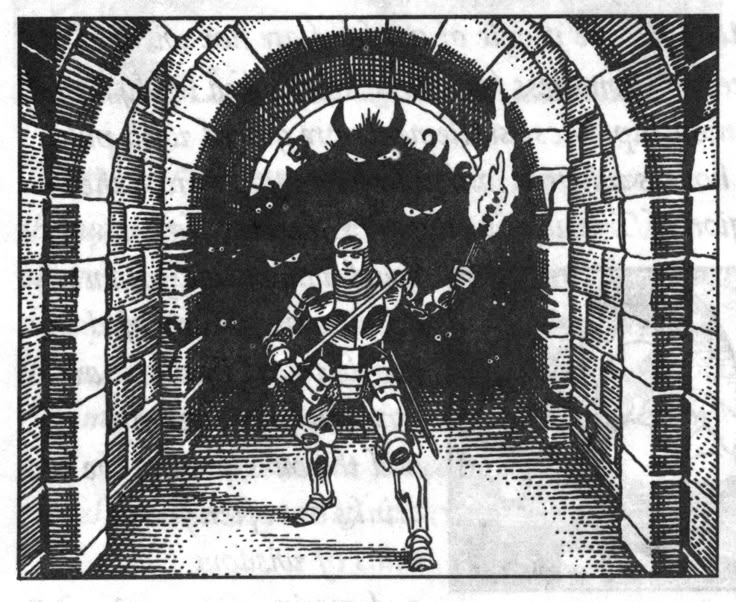
Nestled along the eastern shore of the Pagan Coast, floating in the shimmering expanse of the Winedark Sea, lies the small island of Croy. Its harbor town is a gritty haven for sea-faring rogues and northern sea raiders, who swell its streets seasonally with tales of bloodshed and piles of glittering loot. Yet beneath this raider's hideout sprawls a far older enigma: an ancient temple complex, the Lorn Labyrinth of Tsathoggus, once believed to have engulfed the entire island. Today, only its entrance remains, a dark maw spewing wicked creatures and shadowy spirits onto the surface.
Little is known of the labyrinth's origins or purpose. Whispers in Croy's taverns speak of it as a sacred site to the elder god Tsathoggus, while others warn of a horrific sickness that grips those who linger too long in its depths. Tales of unimaginable horrors and vast treasures echo through the night, luring adventurers to plunge into its inky void. Many vanish without a trace, but a few return, dragging out wealth that fuels the island's legends—and its dangers.
I will leave out the specifics of the dungeon itself outside of basic examples, but another post specifying the dungeon as a playable locale could be warranted should interest arise.
multiple parties
I ran this game as an open table. Anyone could join a session with any character that was rolled up and played in any of the games on the server in which it was run. This made for some interesting challenges that I will describe further below, but doing it in this manner paired well with 1:1 time. It also ensured there was healthy competition between each player as they all wanted to be the one to find the huge hoard before the other. Many have talked at length about multi-party games and character stables in other places, I recommend looking into this topic further if it is a new concept.
the surface
When designing the Lorn Labyrinth it was crucial to have a developed surface environment that the players could interact with as the sessions progressed. This surface environment was initially cryptic and inert, slowly 'unlocking' as the players got deeper into the dungeon. These elements meant that the players could make changes to the dungeon to their advantage at lower levels without actually traveling down to said levels until they were ready to do so. It also meant they could make changes to the dungeon for other players to deal with in the future.
One example of several of the dungeon surface locales was a hall filled with arches. Each arch could be activated by finding a matching arch in the dungeon below. Once activated, this allowed for players to return to that portal location ensuring fast travel to lower levels, but only to the particular room in which the arch was placed. As one can imagine, these quickly became strategic choke points once the monsters figured out the players were coming through them.
the mythical underworld
I found it very helpful to lean into the 'mythical underworld'. The Mythical Underworld as a concept encapsulates the idea of the dungeon as a living, fantastical realm that operates beyond the mundane logic of the surface world—a place steeped in mystery, danger, and otherworldly strangeness. While the term itself isn't explicitly defined in the text, its essence emerges from the rules, descriptions, and implied tone of OD&D. As we can see in Book III of OD&D some elements of a mythical underworld are:
- Doors always swing shut
- Doors are always stuck
- Monsters never have to force doors
- Monsters always see in the dark
- Other living creatures in the dungeon other than the party are considered 'monsters' (even humans)
These rules promote a type of game that has the players outside the realm of a natural explanation for dungeon delving. This gives the referee a lot of freedom as well as acting as a huge deterrent for the players trying to hide out inside the dungeon between sessions.
sun sickness, ending the session in the dungeon, and od&d's 'darkvision' rule
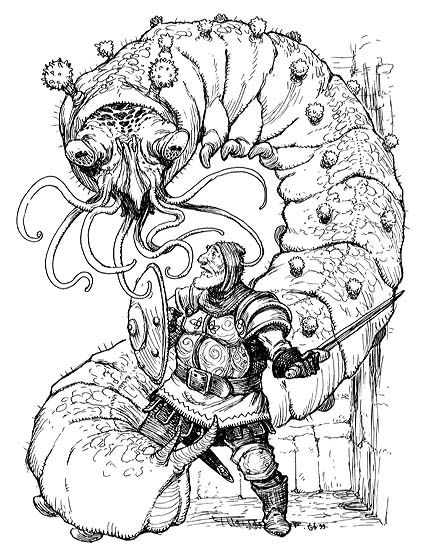
As a way to explain this mythical underworld in the Lorn Labyrinth, I used 'Sun Sickness'. A magical effect that occurs to anyone who spends longer than 24 hours within the dungeon. Once afflicted, your eyes turn black providing you with darkvision but also driving you mad if the sun touches you. This helped explain why the players encountered other classed/leveled characters who had no torches below the surface. By implementing this effect in the dungeon, the fact that players had to escape before the end of the session went without saying. They came to this conclusion totally on their own and would risk immense danger to escape before the end of the session. This one addition solved two issues simultaneously.
the shifting interior between sessions
The Labyrinth itself was constructed from 4"x4" gridded tiles. Each tile had a connection point in the center of each side which lined up with the other tiles for each level. The evenly numbered tiles had stairs down in the center, and the odd numbered tiles had stairs up. Additionally, each tile was thematically consistent as a way to indicate when players entered into a new tile as a way to orient themselves. At the beginning of each session, the tiles were shuffled into a deck (one deck for each level of the dungeon) then drawn off the stack and arranged randomly in a 2x2 square. The key for each tile was kept by identifying each tile with a level and tile number (e.g. L1:T2). Merely shifting the orientation of a tile from north to south confounded players for several sessions, let alone shifting the entrance position. This feature of the dungeon was very exciting for the players at first and prompted lots of discussion between sessions trying to figure out the secret of the dungeon.
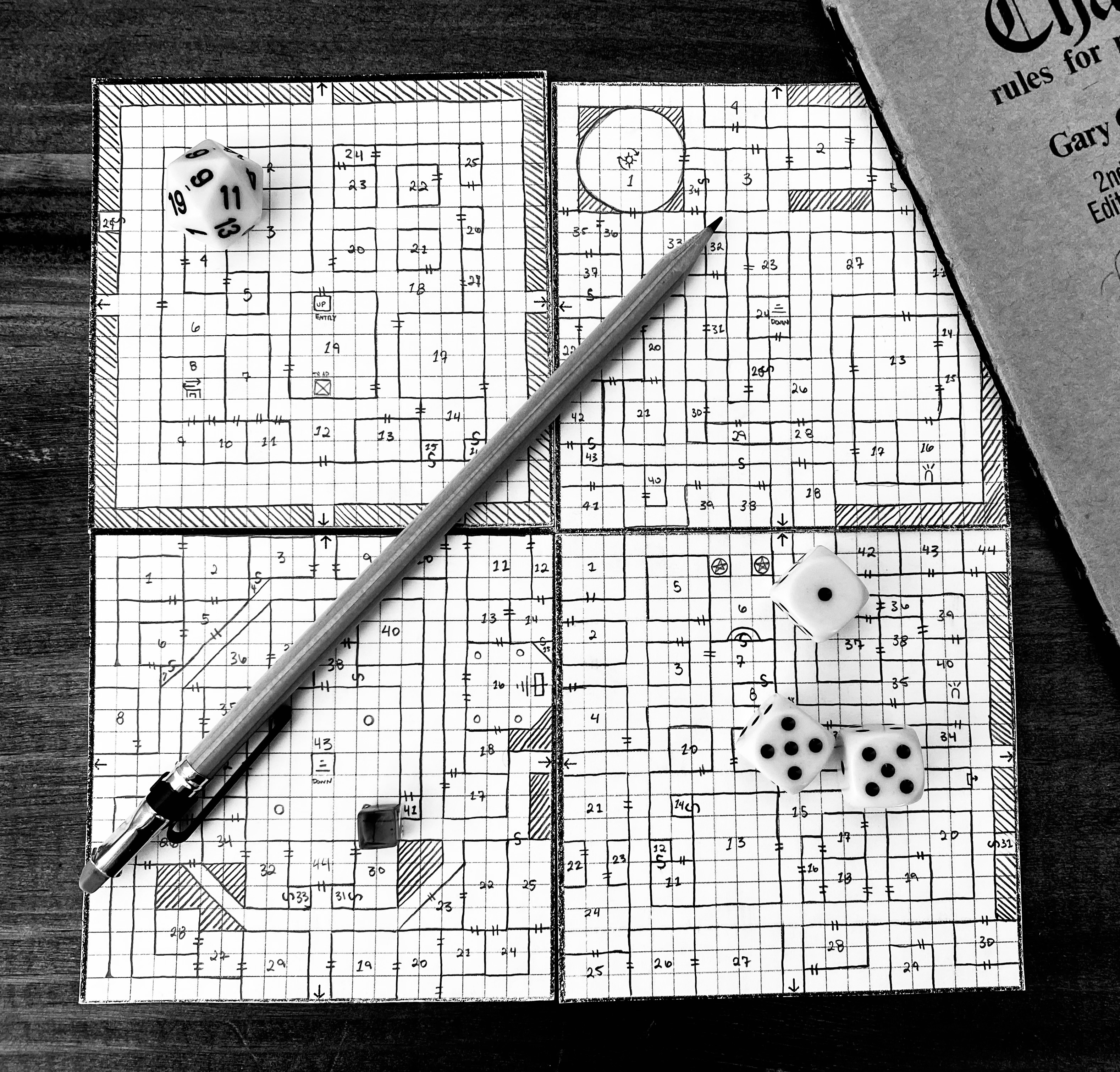
The decision to design the dungeon in this way ensured each delve was unique and no two delves provided the same experience for the players, but my job as the referee's job was already done and prep was kept to a minimum. Since the game was also an open table, there was a possibility for the first few delves to produce a reliable map from which all consecutive groups could navigate the dungeon quickly. Using this shifting method, no group could accurately map the dungeon for the following groups. If a group was very closely paying attention they might catch on to the design method and map each tile, but it would still take some planning on the part of a new group to connect the dots.
About half of the tiles also had rooms with devices that allowed the players to reorient the dungeon tiles into a different pattern. This allowed those in the know to shift the dungeon to orient it to their maps, then navigate to their destination using their hand-drawn maps as a guide. This provided a high skill cap for dungeon navigation without forcing the monotony of constantly feeling totally lost on those who put in effort to figure out the puzzle. Due to the highly predictable position of the up/down stairs, a smart player could quickly find lower levels should they be mapping correctly. Keeping 1:1 time at the back of their mind, the players were constantly pushing to get deeper in the dungeon to "unlock" the next portal so they could skip the upper levels.
restocking the dungeon
Restocking the dungeon has to be done when running 1:1 time as the dungeon is a living location. I made sure to restock the rooms every-other session, going back through the stocking rules in Book III and rolling appropriately. This ensured that all the various groups entering the labyrinth always had level-appropriate treasure to draw out. The bi-weekly restock made it so that players still felt like they could miss out as sometimes rooms would be already looted and monsters slain - "What was in this empty chest? I bet another player was here and has it all." To have the dungeon never restock, would result in a very boring game within just a few sessions as much of the treasure had been found and many of the monsters vanquished. I also tried to follow the advice given in Book III on maintaining freshness by never allowing one tile to remain 100% the same month-to-month:
As monsters inhabiting the rooms, spaces, and corridors of a level are killed or captured, the level will become drab and dull. Coupled with this problem, players will have made fairly accurate maps of the level, so it will be challengeless this way also. Remembering that egress to lower levels is desirable, one must nevertheless revamp worn levels by one or more of the several methods suggested below:
- Make minor alterations with eraser and pencil, blocking passages, making new ones, dividing rooms, and filling in others.
- Extend the boundaries of the map, if not already filled to the edges of the paper, adding corridors and rooms.
- Replace monsters in new areas as well as those less frequented old areas where monsters were located and removed sometime previously.
- Reverse directions on the map, carefully relocating ways down to lower levels so as they still correspond to markings below, and do the same for passages upwards.
- Add a passage which continues past the established boundary of the level, creating a split or sub-level which it leads to, complete with new treasure and monsters.
Using these suggestions, and whatever else you dream up, there is no reason why participants in the campaign should not continue to find mystification, enjoyment, excitement, and amusement in the challenge of the myriad passages of the dungeons.
overworld scope
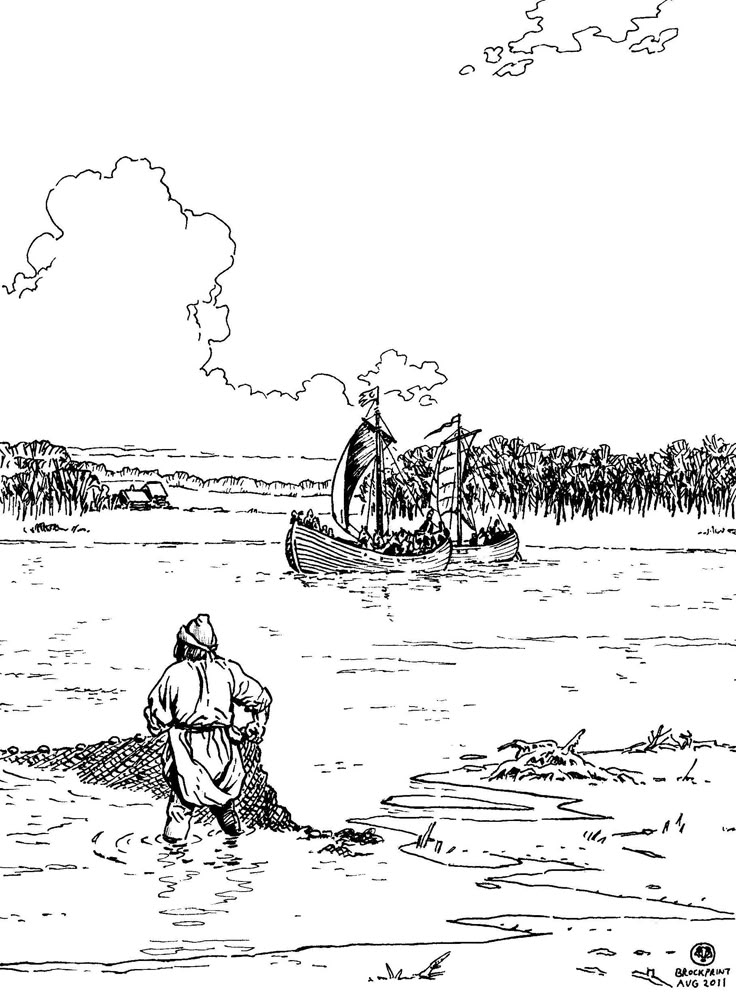
As I was running this game 1:1 time, open table, online, 2hr sessions, I wanted the campaign to be tight and action-packed without slowing it down with details on travel, nearby settlements, etc. For these reasons I placed the dungeon on an island and gave little-to-no information about distant lands. This emphasized the importance of the dungeon to the game I ran.
Thematically since Croy was a port hideout for sea raiders, it was always stocked with plenty of rough-and-tumble hirelings, weapons, and other adventuring goods, as well as wealthy warlords willing to purchase gems, jewelry, and even magic-items who weren't around long enough to be robbed.
This system allowed the players to dump their loot for a good price, and in down time hire men to replace their dead hirelings without getting too slowed down by a mistake or bad delve.
plug-and-play with zero-prep
Running a game like this sounds like a lot of work, but actually became the least amount of prep I've had to do for any game I've run. Limiting the scope of adventure, providing a consistent (but mysterious) system for laying out a 'random' dungeon, and giving predictable and tangible negative consequences for staying inside the dungeon between sessions, I was able to run the game with 0 prep after the initial setup.
Does the initial setup sound like too much? Easy - just get your tiles, label them, then roll the dungeon on the fly using Appendix A. Start each tile with a room in the center with the stairs up. As the dungeon is generated, add connections manually to all the connection points on the tile and you will quickly have yourself a reusable dungeon tile that will serve as an interesting dungeon for sessions on end without losing its newness.
you can run 1:1 megadungeon campaigns
Running a megadungeon with 1:1 time is messy, unpredictable, and demands a referee willing to wrestle with the rules but can turn into something glorious. By leaning into the concept of the mythical underworld and paying attention to the tools provided in the rules a space opens up for running a dungeon this way. Players raced against the clock, mapped what they could, and forged rivalries in a race for treasure, all while Croy's surface offered just enough respite to keep them hooked.
Megadungeons are the beating heart of early D&D for a reason: they're vast playgrounds of loot and danger, low-prep gifts for harried referees, and echoes of legends like Blackmoor and Tonisborg. Pairing them with 1:1 time amplifies that magic, making every day (real or in-game) count.
For play reports and my initial thoughts developing this game, check out #lorn_labyrinth below.
⇦ back to all posts